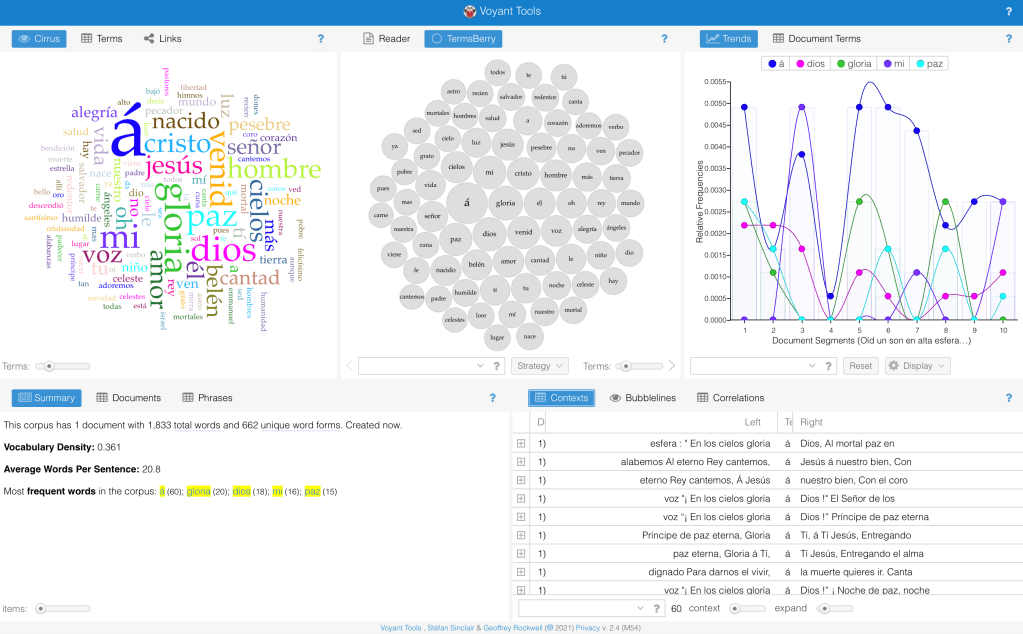
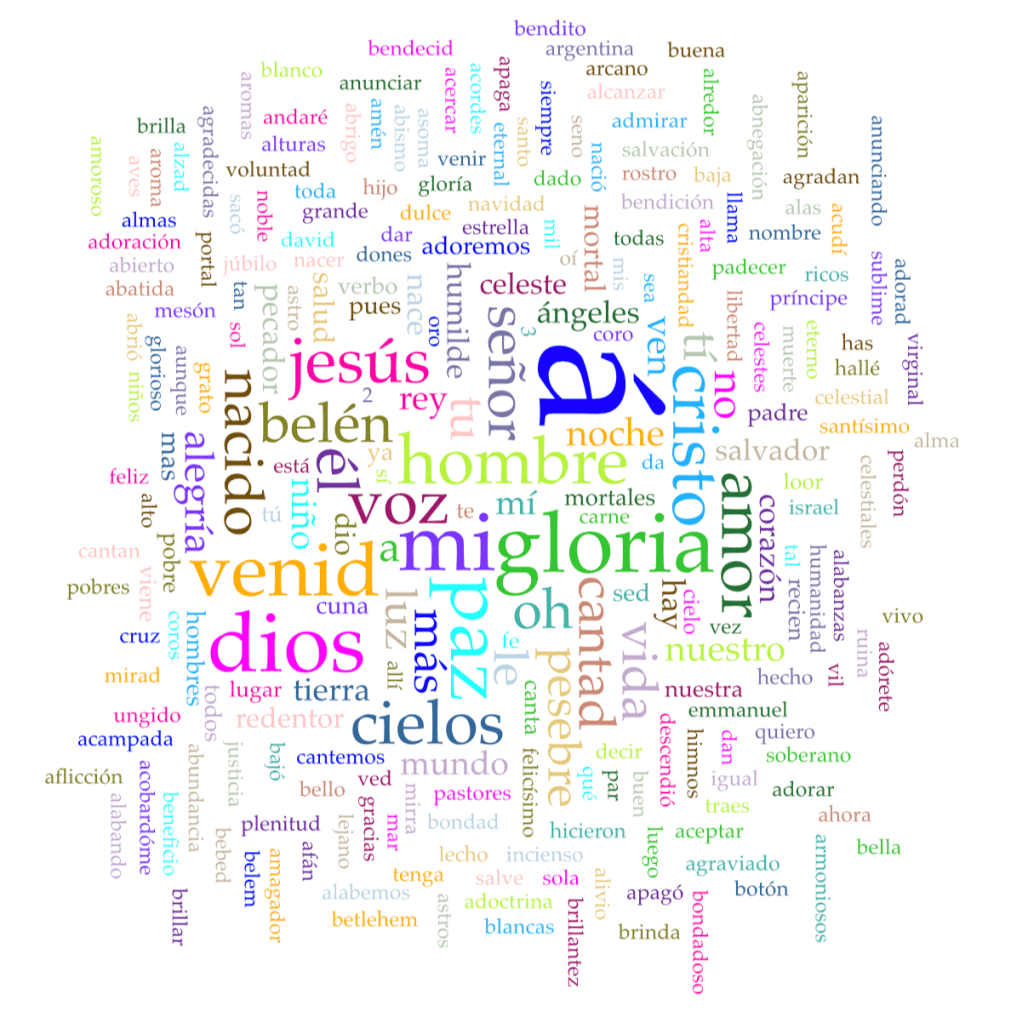
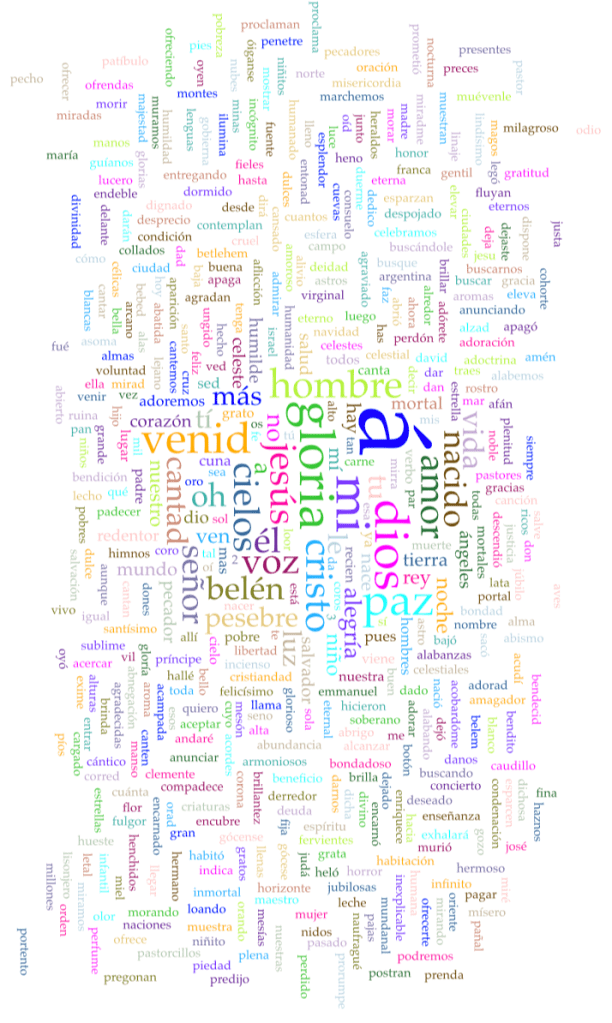
Digital text analysis tools as the one employed here are very useful in the field of hymnology as they can shed new light in . In the Christian Protestant hymnic tradition, text has traditionally superseded music in terms of importance as music has customarily been regarded as an auxiliary means of transmitting the religious message of the Christian gospel. The figures below showcase the results of a CIRRUS (word cloud) text-search feature employed to look at the hymn texts categorized as pertaining to the Nativity of Jesus Christ in the hymnal Himnos Evangélicos (1895). This sample is taken from a total of 18 hymns. By looking at the Cirrus word cloud in the upper left-side corner of Figure 1 or at the three images of Figure 2, we can see that the size of the words correspond to their frequency in the total sample of the 18 Nativity-themed hymns. The most common word is “á,” a preposition with several translations, most notably ‘to,’ that understandably occupies the highest frequency echelon. This is followed by the words “gloria” or ‘glory’ (20 times), “dios” or ‘god’ (18 times), “mí” or ‘me’ (16 times), and “paz” or ‘peace’ (15 times), which stands together in number with “venid” or ‘come.’ Other words that appear frequently are Christ, heavens, love, born, man, Bethlehem, and sing, all related to the Nativity-theme. I think that a very interesting underlying theme is the personal-individual approach of the text in terms of the relationship of God and believer. The frequency of the word ‘me’ showcases the individuality aspect of missional theology in the 19th century, a dogma that has since dwindled in mainline Protestant theology. One other interesting element is the frequency of Christian ‘virtues’ such as love, peace, life, and light, and the author’s intention to connect these to the birth of Jesus Christ. Words relating to the messianic-redemptory message such as salvation, liberty, redemption, and mortals appear as a secondary theme after the “virtue words.” Ultimately, the salvation message is always present, as one would expect from hymns published during the turn of the twentieth century, but the overall theme is actually concentrated in a worship-focused message and a storytelling-focused message.


 Luis Pabón Rico